
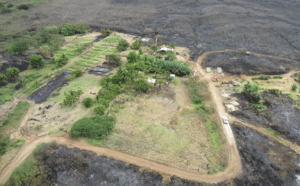
The role that farms and ranches play in land care is critical across fire prone landscapes. Ranches and farms keep fire-prone weeds at bay to maintain pastures and crops.
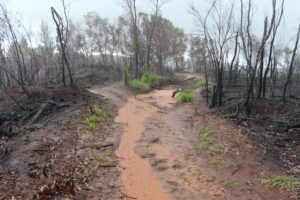
After human health and safety, the first priority is to protect the soils from rain and run-off.
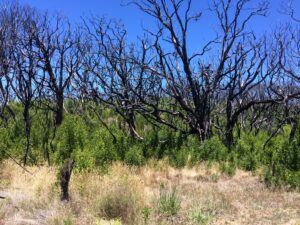
Re-planting is an important, long-term strategy for soil stabilization. While native Hawaiian plants are always desirable, they require a great deal of care, such as water, fencing and weeding.
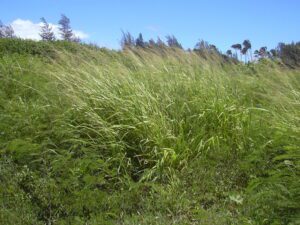
Some introduced grasses in Hawai`i are especially fire prone and present challenges to land owners, land stewards and those concerned with the spread of wildfire. This ID guide is a quick reference to identify and control fire-adapted grasses.
After fire, there are immediate actions you can take to ensure a recovery for the people first of all, soil and water conservation

As wildfire, drought and invasive species increasingly impact native ecosystems, plants and animals, our remaining natural and cultural Hawaiian heritage is more threatened than ever.
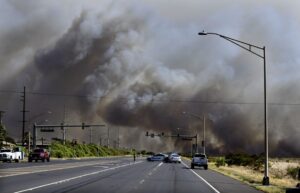
New climate projections for Hawai‘i are based on historical rainfall, and future climate scenarios, such as the footprint of highest fire risk is expected to increase in extent and move upwards in elevation while fire risk may decrease in the driest low elevation areas. This fact sheet summarizes the latest climate change research as it relates to wildfire.
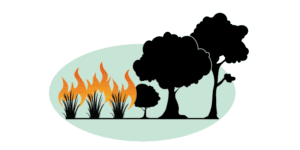
Methodology of weed fire risk assessments. University of Hawai’i at Mānoa’s Kevin Faccenda and Curt Daehler developed a screening system focused on wildfire risk by asking land managers to assign a relative fire risk for…
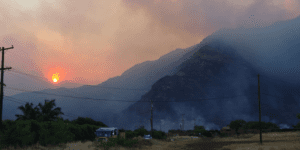
As the climate crisis rages on, wildfires will become ever more frequent, more intense, and more wide-spreading in Hawai’i and across the Pacific. This fact sheet summarizes the latest climate research as…

This review of Hawai‘i’s wildfires in 2019 aims to provide a sense of context for large fires across the state, particularly the abandonment of agriculture that same year.
- « Previous
- 1
- 2
- 3
- 4
- Next »