
What: Are Hawai’i forests adapted to fire, like the Western mainland? What part of the United States has the highest % of land burnt in wildfires? (Hint- it’s not always California!) Do…
We have some neat resources here including a Pacific Fire Exchange slide presentation summarizing best practices for assessing environmental conditions in island environments after wildfire; last month’s very **cool** radio spot, a public service announcement about fireworks in Hawai`i, HWMO’s job announcements which are open until February 5, 2023, and so much more news, research and policy around the Pacific and the continent!
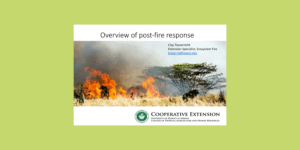
A slide presentation overview by Dr. Clay Trauernicht of best practices for assessing and mitigating after-fire impacts to the environment.
A radio public service announcement created Pacific Media Group about avoiding fireworks in Hawai`i
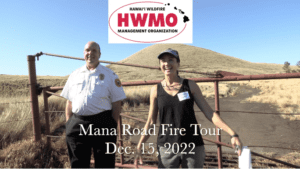
On December 13 -15, 2022 the Hawaiʻi Wildfire Management Organization and wildland fire managers from the western U.S. and Hawaiʻi’s county, state, and federal fire agencies met on Hawai‘i Island. Hawai‘i representatives were able to bring mainland partners up to speed on Hawai‘i’s fire ecology, our mitigation challenges, our collaborative programs to educate and mitigate, and our post-fire stabilization needs and recovery goals via a field tour of one of Hawai‘i’s largest fires in recent history.
We have some amazing partnerships in action including our multi-partner and agency Wildfire Learning Exchange Field Tour on Hawai‘i Island, a **new** Pacific Fire Exchange fact sheet on the climate crisis and possible wildfire risk scenarios in Hawai‘i, an interesting read under the national news section by the Pew Charitable Trust (“Wildfires: Burning Through State Budgets”) and much more!
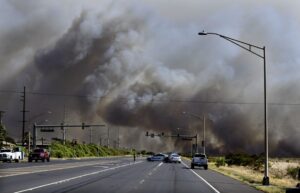
New climate projections for Hawai‘i are based on historical rainfall, and future climate scenarios, such as the footprint of highest fire risk is expected to increase in extent and move upwards in elevation while fire risk may decrease in the driest low elevation areas. This fact sheet summarizes the latest climate change research as it relates to wildfire.
Be sure to check out our latest edition with important Mauna Loa eruption information, the latest climate and weather projections, Hawai‘i’s wildfire situation in the national news (!), a huge Hawai‘i Wildfire push for training up volunteers to assess homes for wildfire risk, our hometown heroes–the Waikōloa Village Firewise Team, a Pacific Fire Exchange Q&A on “Grazing to Reduce Blazing” and so much more.

In this Pacific Fire Exchange talk story Q&A session, we round up the latest research, past and present for managers and landowners wanting to understand more about how our four-legged friends (goats, sheep, cows, etc.) if managed properly can help reduce blazing and wildland fire. This month’s science share out and conversation will be with University of Hawai‘i’s Dr. Mark Thorne, Specialist, State Range and Livestock Extension and Dr. Clay Trauernicht, Fire and Ecosystems Specialist.
Invasive grasses have spread across a quarter of Hawai‘i’s land, and they’re fueling an alarming rise in wildfires. Coalitions are fighting back with new urgency and old tools. By Cynthia Wessendorf